


Divorce headlines can feel chaotic, making it difficult to discern what is truly changing within marriage today.
This article cuts through the noise by presenting clear global patterns rather than scattered facts. You will see how age, income, culture, and shifting expectations influence marriage outcomes across various regions. The goal is to provide a clear understanding of the current state of this ever-important institution.
The data reveal that divorce rates are rising in some places, falling in others, and remaining relatively stable in more traditional societies. These contrasts illustrate how each country’s laws, values, and economic conditions affect a couple’s likelihood of remaining together.
This article consolidates those patterns to help you make sense of them. By the end, you will have a straightforward view of the global shifts shaping divorce and marriage today, ensuring you benefit from the data rather than being misled by confusing headlines. You may even find this information helpful for your own marriage decisions.
Global divorce rates
Divorce rates around the world have been a topic of interest, shaped by various factors across countries. Going deeper into the data reveals that there is no one global story, but rather a mosaic of trends influenced by economic and societal norms.
- Divorce rates are rising globally. The global divorce rate has doubled, rising from 2% in the 1970s to 4% in the 2000s.
- Developed vs. developing nations. In developed countries, 11% of women and 9% of men are divorced or separated by age 35-39 1, compared to only 2% in developing countries for both sexes.
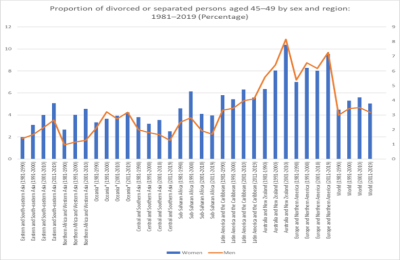
- Gender discrepancy. At the age of 45-49, divorced women outnumber men, with 8-10% in the developed regions 2.
The shift in household composition provides an additional context
Globally, the average age of first marriage has increased to 23 for women and 26.5 for men, mainly due to the rise of continuous education, employment, and increased independence. In contrast, one-parent households (especially single mothers) have risen to 8-10% in many areas, with lone-father households remaining stable at 1-2% 3.
Source: United Nations Department of Economic and Social Affairs. (2020)
Trends by country and region
A sharp and significant contrast is evident across countries in divorce and marriage patterns, shaped by cultural and social change.
Read more: The History of Divorce
Across OECD (Organisation for Economic Co-operation and Development)
The OECD countries reveal complex and evolving family dynamics. While some nations show a rising trend, others exhibit a pronounced decline due to factors such as later marriage, the liberalization of divorce, and cohabitation 4.
- Average divorce rates declined from 5-7 per 1,000 in 1990 to around 4.3 in 2024.
- Countries such as the U.S., Hungary, Latvia, and Türkiye still have marriage rates above 6 per 1,000.
- In 2022, divorce rates ranged from 0.6 per 1,000 in Colombia to 3.6 in Chile.
Across the United States
From 2012 to 2022, the U.S. divorce rate fell even as the marriage rate stayed relatively the same. Some of these patterns reflect changing social norms and may also have been influenced by delays in weddings due to the pandemic.
- In the 1970s, almost 30% of marriages ended within ten years.
- Only 18-19% of those formed in 2010-12 dissolved 5.
- Divorce rates fell from 10 in 2008 to 7 in 2022.
- Marriage rates stayed steady at 16-18 per 1,000, except for the dip during the 2021 pandemic 6.
Across Australia
Australia showed a parallel trend with divorce rates declining from 48,700 in 2023 to 47,216 in 2024.
- The crude rate (divorces per 1,000 of the population) fell from 2.3 to 2.1 per 1,000.
- The median marriage lasted 13.2 years, with the average age at divorce being 47 for men and 44 for women 7.
This is often the result of later-in-life marriages. When both partners are more financially stable and selective, a more deliberate and stable marriage emerges. However, the decline in divorce rates reflects that fewer people are marrying in the first place, with those who do represent a smaller yet more committed group.
Highest and lowest divorce rates in countries across the globe
Rates of divorce vary across countries and exhibit varying trends over time. Some countries have low rates due to strong family ties or repressive laws, while others have a history of higher rates influenced by evolving social attitudes.
Highest in the Maldives
In 2021, the Maldives had the highest crude divorce rate in the world, 8.4 divorces per 1,000 population. The high rate reflects a societal trend of frequent dissolution of unions, as more than half of them were remarried 8.
The majority of them were aged between 25 and 39, with a sharp increase in divorced men and women aged 40. The report inferred that factors such as remarriage and later marriage are both outcomes and indicators of high divorce rates in the Maldives.
Lowest in SriLanka
Sri Lanka has the lowest divorce rate at 0.15 per 1,000 individuals.
This is attributed to their lengthy and complex legal framework rooted in Roman-Dutch, Kandyan, and Islamic traditions. Additionally, arranged marriages guided by compatibility in religion and caste play a significant role, with strong cultural and familial values 9.
Across other regions
A global trend of lower divorce rates is evident in traditional societies, albeit with a gradual increase. A higher pattern is seen in wealthier areas with developed economies and changing gender roles.
- High rates. Australia and New Zealand have more than 10% of women and 8% of men who are divorced/separated. Europe and North America follow similar trends, with 9.5% for women and 7.3% for men 10.
- Gender gap. In diverse countries such as Senegal, Panama, and Russia, women face higher divorce rates, with a gap as large as 15% points.
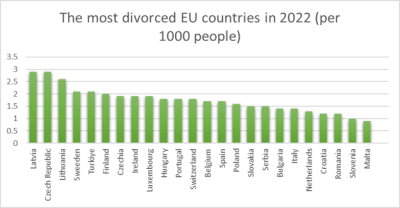
- European snapshot. In 2023, Europe had 1.8 million marriages and 0.7 million divorces. Comparatively, Latvia has 2.8 divorces, and Slovenia has 1.0 divorces per 1,000 people11.
Source: Eurostat (2025)
Major causes of high divorce rates
Global divorce trends show a combination of structural, cultural, and personal factors. According to a study, commonly cited “final straw” triggers were extramarital affairs, domestic violence, and substance abuse, with people more likely to blame their spouse than themselves.
Lack of commitment, infidelity, and finances
In a 2010-12 survey across Britain, the most common reason for divorce for 39% of men and 36% of women was simply them ‘growing apart’ 12.
Additionally, other reasons account for 30%, which are as follows:
- Arguments
- Infidelity
- Disrespect, and
- Financial difficulties
There are also significant gender differences in this regard.
- Financial difficulties among 12% women and 7% men
- Lack of appreciation among 25% women and 17% men
- Unfaithfulness among 24% women and 4% men
- Domestic violence for 16% women and 4% men
Perception through couples’ eyes
Across the Atlantic, in the United States, an online survey of 1,000 Americans highlighted the following reasons for divorce 13:
- Top reasons include lack of family support (34%), incompatibility (31%), financial stress (24%), and infidelity.
- 60% of divorcees stated that the union could have been saved with a better understanding of values or commitment.
- 56% would have liked to know their partner’s values sooner to prevent divorce.
- 40%+ of those suspected of waiting longer before getting married or having children might have achieved success.
Therefore, divorces are not only about personal relationships but also about how societies adjust to changing expectations of marriage, modern pressures, and changing values.
Read more: The History of Marriage
In conclusion: A future outlook
Although the patterns are shifting, people still marry, placing their faith in this time-tested institution.
Even with cultural differences, 4 out of 5 marriages in OECD nations in 2021 were their first unions 14. This shows that the institution still thrives with its social and emotional value, even in the face of historically rising divorce rates.
At the same time, divorce is no longer stigmatized, with people perceiving it as a fresh start rather than a failure, and still encouraging people to pursue long-term relationships. Parallelly, cultural and demographic conditions influence how divorce might develop. Strikingly, in contemporary society, millennials predominate in marriages and consistently hold more liberal views on cohabitation and family structures.
The union is tested before official commitment, which may reduce the possibility of divorce in places like Europe, where almost 90% of couples live together before marriage. However, the risk of divorce may still be higher in dynamics such as India, where younger people marry, and expectations misalign 15.
In general, divorce rates are expected to level off rather than rise, reflecting a balance between evolving standards and customs.
If you want to see more resources on divorce, check out the Family Science Labs. The lab uses the research of the Institute for Life Management Science to produce courses, certifications, podcasts, videos, and other tools. Visit the Family Science Labs today.

Photo by rawpixel.com on Freepik